The metal chair hit my arm hard enough that I heard the bone break before I felt the pain.
One second, I was standing beside the stage in my dress uniform with a Purple Heart pinned over my heart.
The next, I was on the auditorium floor staring at polished black military shoes while my stepmother stood over me gripping a folding chair.
“You think that medal makes you better than us?” Linda screamed.
My left arm lay at an angle that made my stomach turn.
Around us, a room filled with soldiers, veterans, spouses, children, and senior officers had gone completely still.
Then Linda said the thing she had been saying about me for years, only this time she said it loudly enough for the Army to hear.
“You’re still trash in uniform.”
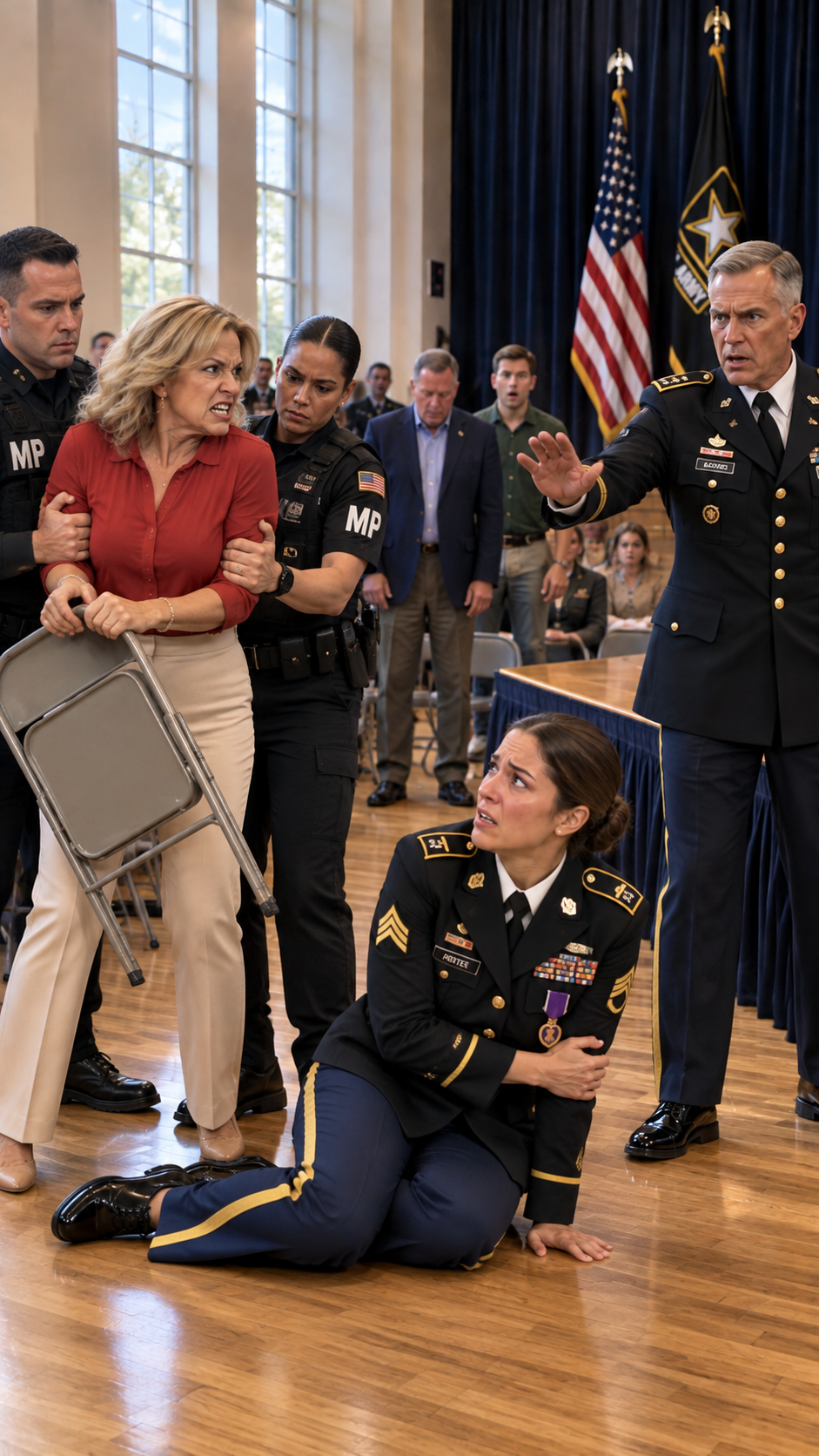
My name is Natalie Porter.
And until that afternoon, my family had no idea who I really was.
Maybe that sounds strange.
They knew where I had been stationed. They knew when I deployed. They knew my rank. They knew I had been injured overseas.
But they had spent so many years reducing everything I accomplished that eventually I stopped explaining anything to them.
Linda called my career “playing soldier.”
My stepbrother, Kyle, called me “GI Jane” whenever he wanted a laugh.
And my father, Richard Porter, had perfected a sentence that allowed him to survive every ugly moment without ever taking responsibility for one.
“That’s just Linda.”
Linda mocked my uniform at Thanksgiving?
That’s just Linda.
Linda told relatives I joined the Army because I couldn’t succeed in the real world?
That’s just Linda.
Linda asked whether I had “earned” promotions by sleeping with somebody?
Natalie, you know how Linda is.
For years, Dad’s cowardice had been dressed up as patience.
I had finally learned the difference.
That was why I almost didn’t invite them to my Purple Heart ceremony.
The auditorium was on a military installation in North Carolina. Flags stood behind the stage, rows of folding chairs filled the floor, and sunlight came through the high windows in long pale strips.
My hands were steady that afternoon.
They had not always been steady since I came home.
There were still sounds that could drag me backward without warning.
Metal hitting pavement.
A helicopter passing too low.
A car backfiring behind me.
Sometimes the smell of diesel was enough.
But that afternoon I felt calm.
My uniform was perfect. My hair was pinned neatly beneath my cap before we entered. My boots were polished.
I had spent too many years learning that courage rarely felt like courage while you were living it.
Usually, it felt like doing the next necessary thing while some part of you was terrified.
Dad, Linda, and Kyle sat in the third row.
Dad wore the navy blazer I had bought him for his sixtieth birthday.
Linda wore cream slacks and a red blouse.
Kyle was thirty-one and had shown up late, carrying an iced coffee and looking as if attending my ceremony were a favor.
When I first spotted them, Dad smiled.
I almost let myself believe that meant something.
Then I saw Linda lean toward Kyle and whisper.
He smirked.
I looked away.
I had survived worse things than their contempt.
Lieutenant General Robert Hayes was seated onstage.
He was a three-star general, but what I noticed when I looked at him was not the stars.
It was the slight stiffness in his right leg.
Two years earlier, I had watched blood soak through his uniform while explosions shook the ground around us.
Nobody in my family knew that.
The official citation was intentionally spare.
When my name was announced, I walked onto the stage.
“Sergeant Natalie Porter.”
The applause began.
I faced forward.
The citation described injuries received as a result of hostile action during an enemy attack.
Technically true.
It did not mention the burning vehicle.
It did not mention the second blast.
It did not mention Hayes.
It did not mention me crawling back when everyone with common sense was moving the other direction.
And it certainly did not mention what Hayes had said when I found him.
Leave me.
I had never told my father any of that.
Hayes pinned the Purple Heart to my uniform himself.
His fingers paused briefly against the fabric.
“Well earned, Sergeant,” he said quietly.
“Thank you, sir.”
Then, even more quietly, he added, “You should have had this ceremony sooner.”
I knew what he meant.
My recovery had delayed things.
So had paperwork.
So had my own reluctance to stand in front of people while they applauded something I still sometimes dreamed about.
When the formal presentation ended, Hayes stepped down from the stage.
His injured leg caught slightly.
I moved automatically.
My hand closed around his forearm.
“Easy, sir.”
He steadied himself and gave me the same dry smile I remembered from overseas.
“Still looking after everyone, Sergeant Porter.”
A few people nearby laughed softly.
Then I heard Linda.
“Look at her.”
I closed my eyes for half a second.
“Always putting on a show.”
I turned.
She was standing beside the aisle.
Dad reached toward her wrist.
“Linda.”
She jerked away.
I said, “Please sit down.”
That should have been the end of it.
Instead, something in her face changed.
Years later, people would ask me why she did it.
I never found one perfect answer.
Jealousy.
Resentment.
Alcohol before the ceremony, according to what investigators later learned.
Years of being able to insult me without consequences.
Maybe all of them.
Linda looked at the medal on my chest.
“You really think you’re something now.”
“This isn’t the place.”
“You invited us here to humiliate us.”
I stared at her.
“What are you talking about?”
“You’ve always wanted everyone to think you’re better than this family.”
Dad stood halfway.
“Linda, come on.”
Too little.
Too late.
She grabbed one of the empty metal folding chairs beside the aisle.
At first, I honestly thought she was moving it.
Then she lifted it.
My training reacted before my mind did.
I raised my left arm and turned my body.
The edge of the chair slammed into my forearm.
CRACK.
Pain detonated from my wrist to my shoulder.
My knees gave way.
I hit the floor beside the stage.
People shouted.
Someone yelled for security.
Another voice called for a medic.
Linda stood over me, breathing hard.
“You think that medal makes you better than us?”
Two military police officers started toward her.
She pointed at me.
“You’re still trash in uniform!”
My vision blurred.
Not from tears.
From pain.
Then she spat out the word she had used privately for years.
“Slut.”
That word did something the broken arm couldn’t.
It took me straight back to being twenty-two, standing in Dad’s kitchen after basic training while Linda asked whether women in the Army “actually worked” or just entertained male soldiers.
I looked toward my father.
He had watched her hit me.
He had watched me fall.
For one stupid second, some childish piece of me waited for him to become my father again.
Stand up.
Say something.
Choose me once.
Dad lowered his eyes.
Kyle laughed.
It was short.
Almost disbelieving.
But it was a laugh.
I will never forget that sound.
Then another voice filled the auditorium.
“Enough.”
General Hayes was standing.
Nobody moved.
Even Linda stopped shouting.
His expression was different from anything I had ever seen on his face.
Not loud anger.
Something colder.
Military police took the chair from Linda and pulled her hands behind her.
She twisted against them.
“She’s my stepdaughter! This is a family matter!”
Hayes stepped forward.
“No, ma’am.”
Linda pointed at me.
“You don’t know what she’s really like!”
Hayes became completely still.
“I know exactly who she is.”
Dad finally looked up.
Hayes turned toward him.
Then he said five words.
“She saved my life overseas.”
Silence.
Not ordinary silence.
The kind where an entire room seems to stop breathing.
My father stared at him.
Linda’s mouth opened.
Kyle’s smile disappeared.
Even I felt something tighten in my chest.
Because Hayes and I had never discussed telling them.
My father whispered, “Natalie never told us that.”
“No,” Hayes said. “She didn’t.”
A medic knelt beside me, but I kept looking at the stage.
Hayes continued.
“Two years ago, during an enemy attack, Sergeant Porter had an opportunity to evacuate.”
His eyes found mine.
“She refused.”
I swallowed.
“Sir.”
He understood the warning in my voice.
I had never wanted that night turned into theater.
But Hayes looked toward Linda, then toward my father.
And for the first time, I realized this was no longer about whether I wanted praise.
It was about whether I was going to let my family’s lies stand unchallenged after Linda had attacked me in front of hundreds of witnesses.
An officer approached the stage carrying a small velvet case.
I recognized him.
Colonel Mason.
My pulse changed.
I had been told there would be “additional remarks.”
Nobody had explained what that meant.
Hayes looked at the case.
Then at me.
“The Purple Heart,” he said, “is not the only reason we asked Sergeant Porter here today.”
Linda’s face lost its color.
And as the medic stabilized my broken arm, the night I had spent two years trying not to talk about began coming back to me in pieces.
Fire.
Dust.
Blood.
Hayes trapped beyond the wreckage.
And my own voice saying the words I had never told my family I had said.
“I’m going back.”
## PART 2: THE NIGHT I NEVER TOLD THEM ABOUT
Two years earlier, I had been convinced I was going to die in the dirt thousands of miles from home.
There was nothing heroic about that thought.
It was simple.
Cold.
Almost boring in its certainty.
We had been moving through an exposed area when the first explosion hit.
I remember the pressure before I remember the sound.
The world seemed to fold inward.
Then everything became dust and screaming.
I hit the ground hard enough to lose my breath.
My ears rang.
For several seconds, I couldn’t tell which direction was up.
Training took over.
Check yourself.
Move.
Find your people.
I pushed onto my knees.
My left side burned.
Blood ran from somewhere near my temple.
Someone shouted my name.
“Porter!”
“I’m up!”
A vehicle was burning.
Smoke rolled across the road.
Another soldier was dragging a wounded man toward cover.
We had casualties.
We also had every reason to believe another attack was coming.
I moved toward the evacuation point, helping where I could.
That was when somebody shouted that General Hayes was missing.
He had been traveling with the group as part of an operational visit.
The last anyone had seen, he had been near the second vehicle.
I looked back.
The entire area seemed wrong.
Smoke.
Flames.
Fragments of metal.
People yelling to move.
There are moments in life when you have time to debate yourself.
That wasn’t one of them.
I knew Hayes was somewhere behind us.
I also knew I had a path out.
I turned around.
One of the soldiers near me grabbed my vest.
“Porter, where are you going?”
“Hayes is back there.”
“Recovery team’s coming.”
I looked through the smoke.
Maybe they were.
Maybe they would reach him.
Maybe they wouldn’t.
Then I heard another explosion in the distance.
I pulled free.
“I’m going back.”
I found Hayes behind part of the damaged vehicle.
His leg was badly injured.
Blood covered his uniform.
He was conscious, but barely.
When he saw me, his expression hardened.
“Sergeant, get out.”
“No.”
“That is an order.”
“Respectfully, sir, terrible order.”
Even then, he almost laughed.
Then he grimaced.
I checked what I could.
My hands were shaking.
That is another thing nobody tells you about courage.
Your hands can shake while you do exactly what needs to be done.
I worked to control the bleeding.
Hayes grabbed my sleeve.
“You need to move.”
“So do you.”
“I’m slowing you down.”
“Yes, sir.”
His eyes narrowed.
I got an arm under him.
“So help me make this less embarrassing.”
He was heavier than I expected.
Or maybe I was weaker than I realized.
My own injuries were beginning to catch up with me.
We moved in ugly increments.
A few feet.
Stop.
Breathe.
Move again.
At one point I stumbled and nearly dropped him.
He said, “Leave me.”
I remember becoming angry.
Actually angry.
“Sir, if you say that again, I’m reporting you for being annoying.”
That time he did laugh.
One short breath.
Then another blast hit.
Something struck me.
I went down.
For several seconds I saw nothing but white.
When my vision returned, Hayes was calling my name.
“Natalie.”
Not Porter.
Natalie.
I pushed myself up.
My body was telling me to stay down.
I didn’t.
Other soldiers reached us before I had to find out how much farther I could have gone.
They took Hayes.
Someone tried to take me too.
I remember arguing.
Then I remember waking under bright lights.
Afterward, people used words I hated.
Brave.
Heroic.
Selfless.
What I remembered was fear.
I remembered thinking about Dad.
I remembered wondering whether he would answer if somebody called him in the middle of the night.
I remembered Linda’s voice from before deployment.
“Try not to get yourself killed playing hero.”
I had almost died.
When I finally returned home months later, Linda took one look at the lingering stiffness in my movement and said, “Maybe now you’ll finally get a normal job.”
Dad said nothing.
That was when something in me shut down.
I stopped telling them things.
Not because the mission was classified in some dramatic way.
There were details I couldn’t discuss, of course.
But eventually, I could have told them the broad truth.
I simply didn’t want to.
I had learned that giving Linda something meaningful was like handing her a clean glass and waiting for her to spit into it.
So I let them believe the injury had been ordinary.
I let them call my service a phase.
I let Kyle make jokes.
Not because they were right.
Because I no longer needed them to understand.
At least, that was what I told myself.
Back in the auditorium, my arm throbbed beneath the medic’s temporary splint.
Linda had been pulled several feet away.
Her confidence was gone.
General Hayes addressed the room.
“Sergeant Porter did not simply remain behind during an attack. She moved back into danger while already injured.”
I stared at the floor.
Colonel Mason stood beside him with the velvet case.
Hayes continued.
“She reached me when I could not move under my own power. She controlled bleeding, refused to abandon me, and helped move me toward extraction despite sustaining additional injuries herself.”
Dad was crying.
I saw it without wanting to.
Linda said, “She never told us.”
Hayes looked at her.
“That appears to say more about your family than it does about Sergeant Porter.”
Nobody laughed.
Linda looked toward Dad as if expecting him to rescue her.
For once, he didn’t.
But I wasn’t ready to give him credit for that.
Hayes turned toward me.
“The recommendation went through extensive review. Sergeant Porter has never asked for recognition beyond what her soldiers received. In fact, she repeatedly redirected attention away from herself.”
Colonel Mason opened the case.
Inside was another military decoration.
My throat tightened.
I had known there had been a recommendation.
I had not known the final decision had been completed.
Hayes said, “The Army has approved an additional valor award recognizing Sergeant Porter’s actions during that attack.”
Applause began somewhere behind me.
Then spread.
I wanted to disappear.
I also wanted, for the first time in years, not to.
The medic leaned close.
“Sergeant, we need to get you evaluated.”
“I know.”
Hayes heard him.
He nodded.
“We’ll finish this properly when Sergeant Porter can stand without someone breaking another bone.”
A ripple of grim laughter moved through the room.
Linda flinched.
Military police started escorting her out.
She twisted around.
“Natalie!”
I looked at her.
For years, hearing my name in that tone had made my stomach tighten.
Not anymore.
“This is ridiculous!” she shouted. “Tell them! Tell them I didn’t mean to break your arm!”
I said nothing.
“Natalie!”
The doors closed behind her.
Then I looked toward Kyle.
He wasn’t laughing now.
He stood beside Dad with his hands buried in his pockets.
Dad stepped toward me.
“Natalie, I—”
I raised my good hand.
“Don’t.”
He stopped.
The medic helped me onto a stretcher.
Dad followed.
“I didn’t know.”
Those three words almost made me laugh.
“You didn’t know she hit me?”
“No. I mean about overseas.”
“That doesn’t matter.”
His face crumpled.
“It does to me.”
And that was when I finally said the thing I should have said years earlier.
“That’s the problem, Dad.”
He stared at me.
“It shouldn’t have taken a general telling you I was worth something.”
The medic began wheeling me toward the doors.
Dad stood there.
I thought the worst part was over.
I was wrong.
Because at the hospital, while doctors worked on my arm, my father finally told me what Linda had been saying about me when I wasn’t around.
And I discovered that his silence had gone much deeper than I knew.
## PART 3: WHAT MY FATHER ALLOWED
The break was clean.
That was the good news.
The bad news was that I would spend the next several weeks in a cast, and every movement reminded me that my stepmother had attacked me at my own military ceremony.
I sat on the hospital bed staring at my fingers while the swelling slowly increased.
A nurse had cut part of my uniform sleeve to get access to my arm.
I hated that more than I expected.
The Purple Heart had been removed for safekeeping and placed in a small plastic belongings bag on the table.
A medal in plastic.
A torn uniform.
A broken arm.
It felt almost absurd.
There was a knock.
Dad stood in the doorway.
Kyle was behind him.
“No,” I said.
Dad stopped.
“Please.”
“I don’t want Linda here.”
“She isn’t.”
“Then where is she?”
“With military police.”
The words hung between us.
This was not one of Linda’s Thanksgiving tantrums.
Not an argument that could be smoothed over by dessert.
She had assaulted me in a room full of witnesses.
There would be consequences whether my father liked them or not.
Kyle stepped inside.
For the first time in my life, he looked uncertain around me.
“Natalie.”
I looked at him.
He glanced at my cast.
“I’m sorry.”
“For what?”
His face reddened.
“For laughing.”
“You thought it was funny.”
“I didn’t understand how bad it was.”
“The chair hit hard enough for the entire room to hear my arm break.”
He had no answer.
I looked at Dad.
“What do you want?”
He sat in the chair near the wall.
For a long moment, he said nothing.
Then he whispered, “I failed you.”
I had imagined hearing those words for years.
They gave me less satisfaction than I expected.
“Yes.”
He winced.
I didn’t soften it.
Dad rubbed his hands together.
“Linda has always been jealous of you.”
“That’s not an explanation.”
“I know.”
“Then don’t make it one.”
He nodded.
After a moment, he said, “She used to say you joined the Army to embarrass us.”
I frowned.
“Embarrass you how?”
“She said you wanted people to think you were tougher than Kyle. More successful than him.”
Kyle looked away.
I stared between them.
“So this was about Kyle?”
“No,” Kyle said quickly.
Dad exhaled.
“Not exactly.”
Then he told me.
Every promotion I received had become a fight in their house.
When I made sergeant, Linda apparently spent an entire evening complaining that I would “rub it in Kyle’s face.”
I hadn’t even spoken to Kyle that month.
When I deployed, Linda told relatives I had volunteered because I loved attention.
When I came home injured, she suggested to people that the injuries were less serious than I claimed.
And when the invitation to the Purple Heart ceremony arrived, Linda had become obsessed with the idea that I had arranged the ceremony to publicly prove that I was the “successful child.”
I stared at Dad.
“And what did you say?”
Silence.
I already knew.
“Dad.”
“I tried not to make things worse.”
Something inside me went cold.
“For whom?”
He looked at me.
“For whom did you try not to make things worse?”
He couldn’t answer.
Because the answer was Linda.
It had always been Linda.
Keeping peace meant I absorbed the insult.
Keeping peace meant I left early.
Keeping peace meant Linda was never confronted.
Keeping peace meant Dad could tell himself he had a family as long as I was willing to pay for the illusion.
Kyle sat down.
“I should’ve said something too.”
I looked at him.
“Yes.”
His eyes dropped.
I didn’t hate Kyle.
That almost made it worse.
He had learned from Dad.
Stay quiet while Linda chose her target.
Laugh if necessary.
Be grateful it wasn’t you.
Dad’s voice shook.
“When General Hayes said you saved his life…”
“Stop.”
He looked up.
“Don’t use that to make this easier.”
“I don’t understand.”
“You’re looking at me differently now.”
“Of course I am.”
“Exactly.”
He stared.
I leaned forward despite the ache in my arm.
“I was your daughter yesterday.”
His face changed.
“I was your daughter when she called me a slut. I was your daughter when she mocked my injuries. I was your daughter when she told everyone I was playing soldier. I was your daughter when she lifted that chair.”
“Natalie—”
“And you looked down.”
Tears filled his eyes.
“I was shocked.”
“So was I. I still managed to raise an arm.”
Kyle inhaled sharply.
Dad closed his eyes.
For once, I let the silence hurt him instead of rushing to rescue him from it.
A knock came at the door.
General Hayes entered.
He was no longer wearing the expression he had worn in the auditorium.
Now he looked tired.
Older.
Human.
He asked Dad and Kyle to give us a moment.
Dad hesitated.
I said, “Please.”
They left.
Hayes sat.
“How’s the arm?”
“Still attached.”
“Army medicine works miracles.”
I smiled despite myself.
Then I looked toward the bag containing the medal.
“Sir, you didn’t have to tell them.”
“I know.”
“Why did you?”
He considered the question.
“Because she attacked one of my soldiers and then claimed I didn’t know who that soldier was.”
My eyes dropped.
He continued more gently.
“You have never needed me to explain your value, Natalie.”
“No, sir.”
“But I suspect you’ve spent a long time pretending their opinion doesn’t hurt.”
That landed harder than I wanted it to.
I stared at him.
Hayes nodded toward the hallway.
“You can be strong and still be wounded by your family.”
I swallowed.
“I know.”
“Do you?”
I didn’t answer.
He didn’t push.
Instead, he told me the additional award ceremony would be rescheduled.
I shook my head.
“I don’t want another ceremony.”
“I suspected you might say that.”
“Then why ask?”
“Because this time, I want you to decide after you’re no longer sitting in a hospital with a broken arm.”
Fair.
Before leaving, he paused.
“One more thing.”
“Yes, sir?”
“Military police will need your statement. There were many witnesses. But what happens next should include your voice.”
I understood.
Linda had spent years teaching me that the easiest way to survive her was to minimize everything.
Don’t react.
Don’t provoke her.
Don’t make Dad choose.
For the first time, I saw how deeply that instinct had followed me.
“What if my father asks me not to press this?”
Hayes’s expression did not change.
“Then your father will have made another choice.”
After he left, I stared at the door for a long time.
Dad did ask.
Not immediately.
He waited until that evening.
He came back alone and sat beside the window.
He apologized again.
Then he said Linda had never done anything “like this” before.
I laughed once.
“What does that mean?”
“She lost control.”
“She picked up a chair and swung it at me.”
“I know.”
“She called me trash while I was on the floor.”
“I know.”
His voice cracked.
“She could go to jail.”
There it was.
The request hidden inside the observation.
I looked at him.
“Are you asking me to protect her?”
“No.”
“Dad.”
He covered his face.
“I don’t know.”
I felt strangely calm.
Maybe because I finally understood the rules.
Linda hurt me.
Dad felt bad.
Then I was expected to reduce the consequences so Dad wouldn’t have to experience discomfort.
I had been playing that role since I was a teenager.
Not anymore.
“I am giving a full statement.”
He lowered his hands.
“Natalie.”
“And I won’t lie for her.”
“I didn’t ask you to lie.”
“You were about to ask me to make it smaller.”
He looked away.
I pressed the call button for the nurse.
Not because I needed medication.
Because I needed the conversation to end.
“Go home, Dad.”
He stood slowly.
At the doorway, he turned.
“I do love you.”
I believed him.
That was the tragedy.
“I know.”
He waited.
I said, “But love without courage hasn’t protected me very well.”
He left.
The following morning, I gave my statement.
Every word.
Every insult.
The chair.
The impact.
Dad lowering his eyes.
Kyle laughing.
I did not exaggerate.
I did not minimize.
And when the investigator closed the notebook, I felt something I hadn’t expected.
Relief.
But Linda wasn’t finished.
Two days later, she called me from detention.
And the first thing she said was not “I’m sorry.”
It was:
“Look what you’ve done to this family.”
## PART 4: I STOPPED PROTECTING THEM
I almost hung up.
Almost.
Instead, I held the phone to my ear with my good hand and listened.
Linda sounded furious.
Not ashamed.
Not frightened.
Furious.
“You’ve made your point,” she said.
“My point?”
“You humiliated me in front of everyone.”
I stared at the hospital discharge papers on my kitchen table.
I had gone home that morning.
My arm was casted from below the elbow nearly to the shoulder.
“You hit me with a chair.”
“You were provoking me.”
“I told you to sit down.”
“You always have that tone.”
There it was.
The magical tone that apparently justified everything.
I said, “Why did you call?”
“Your father is devastated.”
“Then you should apologize to him too.”
Silence.
“You’ve turned him against me.”
“No, Linda. You swung a chair in front of a three-star general.”
Her voice sharpened.
“You always thought you were better than us.”
I looked around my apartment.
Nothing glamorous.
A couch.
A stack of recovery paperwork.
A mug from my unit.
A framed photograph of several of us overseas.
I had spent years trying to prove I didn’t think I was better.
I made myself smaller at holidays.
I avoided talking about promotions.
I changed the subject whenever Dad asked about commendations because Linda would roll her eyes.
And she had still hated me.
That was the realization that finally freed me.
There had never been a version of me small enough to satisfy her.
“I don’t think I’m better than you,” I said.
She scoffed.
“But I do think I’m done letting you treat me like I’m less.”
She started talking over me.
I ended the call.
My hand shook afterward.
I set the phone down.
For several minutes, I simply sat there.
Then I cried.
Not because I regretted it.
Because boundaries sound powerful when people talk about them after the fact.
In reality, the first boundary can feel like grief.
You’re not only saying no to mistreatment.
You’re saying goodbye to the fantasy that if you endure long enough, the person hurting you will eventually become the person you needed.
Dad called that night.
I didn’t answer.
Kyle texted.
**Can I come by?**
I stared at it.
Then wrote:
**Tomorrow. Noon. Alone.**
He arrived with takeout and an expression I had never seen on him.
Shame.
I let him in.
He placed the food on the counter.
“I know sorry isn’t enough.”
“No.”
He nodded.
“I laughed because Mom trained me to laugh when she went after you.”
I looked at him.
He rushed to clarify.
“That’s not me blaming her. I did it. I’m thirty-one years old. I knew better.”
That was the first thing anyone in my family had said that sounded like accountability.
So I listened.
Kyle told me he had spent most of his life enjoying the comparison Linda invented between us.
If I failed, he felt safer.
If I succeeded, Linda explained why it didn’t count.
When he dropped out of college, she said at least he hadn’t “run off to play soldier.”
When I was promoted, she said the Army handed out rank to make women feel special.
When I returned injured, Linda told Kyle privately that I was probably exaggerating.
“Did you believe her?” I asked.
He hesitated.
“Sometimes.”
That hurt.
He looked at my cast.
“Then I saw that general.”
I stiffened.
Kyle noticed.
“No. That’s not what I mean.”
“Sounds like it.”
“I don’t mean I respect you because a general does.”
“Then what?”
He swallowed.
“I saw the way he looked at you when Mom hit you.”
I waited.
“He looked at you like you mattered.”
The room went quiet.
Kyle rubbed his palms over his jeans.
“And then I realized how weird it was that a man who barely sees you anymore could look at you like that, but your own father and brother were standing there acting like what happened wasn’t real.”
I didn’t know what to say.
He continued.
“I laughed because that was what I always did when Mom attacked you.”
“Yes.”
“And then everyone else reacted like normal people.”
That sentence stayed with me.
Normal people.
People who had never met me stood up.
Medics ran toward me.
Military police restrained Linda.
Veterans looked horrified.
A general intervened.
My own family had behaved as if we were still inside Dad’s house where Linda got to decide what counted as normal.
Kyle’s eyes filled.
“I don’t expect you to forgive me.”
“Good.”
He nodded.
“But I want to stop being that person.”
“That part is up to you.”
He left after an hour.
I didn’t hug him.
I also didn’t tell him never to come back.
For the moment, that was enough.
The investigation moved quickly because there was no dispute over what happened.
Too many witnesses.
Too much video.
Linda had attacked me in a military auditorium in front of security personnel.
There was no way to turn it into a private misunderstanding.
Dad tried once more to talk about leniency.
I ended the conversation.
Three days later, he came back.
This time he did not ask me to save Linda.
He brought a box.
Inside were things I hadn’t seen in years.
My high school graduation photograph.
A letter I had sent him from training.
A picture of me in uniform after my first promotion.
Cards.
Newspaper clippings.
I looked up.
“What is this?”
“Things I kept.”
My throat tightened despite myself.
Dad sat across from me.
“I need you to understand something.”
“Okay.”
“I was proud of you.”
I said nothing.
“I was always proud.”
“Then why did you let her make pride feel like shame?


